

What is the thermal conductivity of jelly fuel?
Jul 29, 2025
What is the Thermal Conductivity of Jelly Fuel?
As a supplier of jelly fuel, I often get asked about the thermal conductivity of this unique energy source. Thermal conductivity is a crucial property that determines how well a material can transfer heat. In the context of jelly fuel, understanding its thermal conductivity is essential for various applications, from chafing dishes in the catering industry to outdoor heating solutions.
Understanding Thermal Conductivity
Before delving into the thermal conductivity of jelly fuel, let's briefly understand what thermal conductivity is. Thermal conductivity, denoted by the symbol "k," is a measure of a material's ability to conduct heat. It is defined as the quantity of heat (Q) that passes through a unit area (A) of a material in a unit time (t) under a temperature gradient (ΔT) across a unit thickness (L). Mathematically, it can be expressed as:
[k=\frac{Q\times L}{A\times t\times\Delta T}]
The SI unit of thermal conductivity is watts per meter-kelvin (W/(m·K)). A high thermal conductivity value indicates that a material can transfer heat quickly, while a low value means that the material is a poor conductor of heat and may act as an insulator.

Factors Affecting the Thermal Conductivity of Jelly Fuel
The thermal conductivity of jelly fuel is influenced by several factors, including its composition, density, and temperature.
- Composition: Jelly fuel is typically made by gelling a liquid fuel, such as ethanol or methanol, with a gelling agent. The type of fuel and gelling agent used can significantly affect the thermal conductivity. For example, ethanol has a relatively high thermal conductivity compared to some other fuels, and the addition of a gelling agent can alter the heat transfer properties of the fuel.
- Density: The density of jelly fuel also plays a role in its thermal conductivity. A higher density generally means that there are more molecules per unit volume, which can facilitate better heat transfer. However, the structure of the gel can also affect how heat is conducted through the material.
- Temperature: Like most materials, the thermal conductivity of jelly fuel can change with temperature. In general, the thermal conductivity of liquids and gels tends to increase with temperature, as the molecules have more kinetic energy and can transfer heat more efficiently.
Measuring the Thermal Conductivity of Jelly Fuel
Measuring the thermal conductivity of jelly fuel can be challenging due to its gel-like nature. Traditional methods for measuring thermal conductivity, such as the guarded hot plate method or the transient hot wire method, may need to be adapted to account for the unique properties of the gel.
One approach is to use a modified version of the transient hot wire method, where a thin wire is embedded in the jelly fuel and a current is passed through the wire to generate heat. The temperature rise of the wire is measured as a function of time, and the thermal conductivity of the jelly fuel can be calculated based on the rate of temperature increase.
Another method is to use a differential scanning calorimeter (DSC) to measure the heat flow through the jelly fuel. By comparing the heat flow through the jelly fuel with a reference material of known thermal conductivity, the thermal conductivity of the jelly fuel can be determined.
Importance of Thermal Conductivity in Jelly Fuel Applications
The thermal conductivity of jelly fuel is important in various applications, especially in the catering and hospitality industry.
- Chafing Dishes: Chafing dishes are used to keep food warm during buffet-style events. Jelly fuel is a popular choice for chafing dishes because it burns cleanly and produces a consistent flame. The thermal conductivity of the jelly fuel determines how quickly it can transfer heat to the water in the chafing dish, which in turn heats the food. A higher thermal conductivity means that the food can be kept at a desired temperature more efficiently.
- Outdoor Heating: Jelly fuel can also be used for outdoor heating, such as in patio heaters or portable fire pits. In these applications, the thermal conductivity of the jelly fuel affects how quickly the heat is radiated into the surrounding environment. A higher thermal conductivity can result in a more effective heating solution.
Our Jelly Fuel Products and Their Thermal Properties
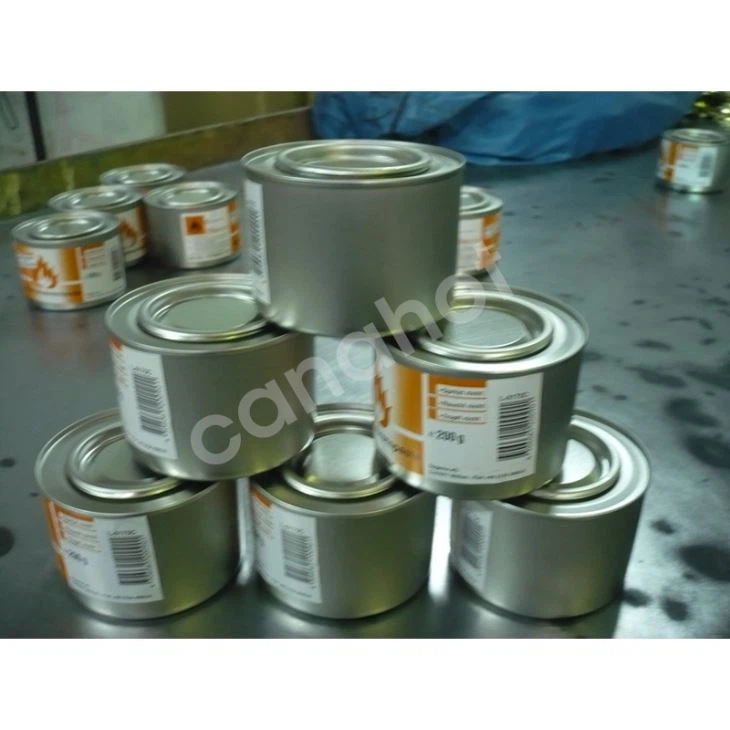
At our company, we offer a range of jelly fuel products designed for different applications. Our 4hrs Liquid Wick Chafing Fuel Screw Cap is specifically formulated for use in chafing dishes. It has a balanced thermal conductivity that allows for efficient heat transfer to the water in the chafing dish, ensuring that the food stays warm for up to four hours.
Our Ethanol Chafing Gel Fuel is made from high-quality ethanol and a specially designed gelling agent. The ethanol provides a relatively high thermal conductivity, while the gelling agent helps to maintain the shape of the fuel and prevent spills. This fuel is ideal for catering events where a clean and efficient heat source is required.
For those looking for a reusable option, our Reusable Canned 2h/3h Gel Alcohol Paste/methanol Fuel, Smokeless, Odorless and Non-toxic Fuel is a great choice. It has a stable thermal conductivity that allows for consistent heat output over a period of two to three hours. The fuel is also smokeless, odorless, and non-toxic, making it safe for use in indoor and outdoor settings.
Contact Us for Procurement and Discussion
If you are interested in learning more about our jelly fuel products or have any questions about their thermal conductivity, we encourage you to contact us. Our team of experts is available to discuss your specific needs and provide you with detailed information about our products. Whether you are a caterer, event planner, or simply looking for a reliable heat source for your outdoor activities, we have the right jelly fuel solution for you.
References
- Incropera, F. P., DeWitt, D. P., Bergman, T. L., & Lavine, A. S. (2007). Fundamentals of Heat and Mass Transfer. John Wiley & Sons.
- Holman, J. P. (2010). Heat Transfer. McGraw-Hill.